Showing posts with label Sermons (The neglected women of the Bible). Show all posts

Tuesday, 16 January 2024

‘A full Christ is for empty sinners’ (2 Kings 4)

Is the Bible sexist?  You see, so often in the Bible it is women who are portrayed as having the faith that men lack.  Then there is the fact that God reveals His special care for people like widows.  Why are women so often shown in better light than men?

In the book of Hebrews, we read that by faith, ‘women received back their dead to life again’ (Hebrews 11:35).  It was women who exercised this extra-ordinary faith and received this amazing blessing.  There are two recorded raising of the dead in the Old Testament, both in the books of Kings and both to of the sons of widows.

I think it is because women are often more marginalised, and that marginalised people are quicker to cry to God for help.

In our reading we have three little stories that each show the faithfulness of God to people who are in desperation.

1.        Filling for the empty (1-7)

This widow goes to the prophet Elisha and explains that ‘the creditor has come to take my two children to be his slaves’.  In the ancient near east a person could be made a slave in order to pay off a debt.  In God’s mercy He regulated this practice in His law and put time limits on it.

All this woman has is a jar of oil.  Elisha tells her to gather empty jars from her neighbours.  She does so, and God fills those jars.  Her debts are paid, and they have oil to live off.

The great preacher Spurgeon comments on these verses saying, ‘a full Christ is for empty sinners only … it is not our emptiness, but our fullness that can hinder the outpouring of free grace.’  It is only empty vessels that get filled.

One of the reasons that people like widows show such faith in the Old Testament is because their situation made them vulnerable.  They knew that they needed help.  They knew that they needed God’s help.  It is only when we face up to our brokenness that we can grow in faith.

2.       Life for the desperate (8-37)

Then we come to a wealthy Shunamite woman.  Another woman who is aware of her need.  Another example of God’s provision.

She practices hospitality, which is something highly valued in the Bible.  Elisha tells her that God is going to give her a son.  The son comes, years go by, and then the son dies.  She lays the dead boy’s body out on the bed that she has for Elisha in her home.

One commentator says, ‘the woman lost her child but not her faith’ (Wiseman).

Now look at how the men in this story fail.  She doesn’t tell her husband that the boy is dead, presumably because he doesn’t share her strength of faith and might tell her not to bother Elisha.  Then there is Gehazi, Elisha’s servant, who tries to keep the woman from the prophet.  Even Elisha does not seem to know when his original plan fails.  But she says, ‘I am not leaving you’.  She seems to know better than Elisha what was needed.

This determined and persistent faith is often shown in how Christian mothers pray for their spiritually dead children.  In the fourth century a woman called Monica would not give up praying for her spiritually lost son, Augustine.  He was found by God and become one of the greatest Christian theologians of all time.

Do you notice her repeated response to people, ‘it is well’?  Commentators suggest that what she is doing is pushing enquires aside so that they don’t get in the way of her getting to Elisha.  But I wonder if these are also words of faith.  It is well, because God will make it well.  I was working on this text around the time I found out that my dad was not going to be allowed home from the hospital, but would have to go to a nursing home.  I felt that God was saying, ‘it is well’, it will turn out well.

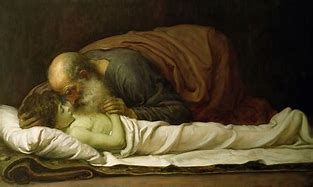
The healing itself is a scene of shocking intimacy.  It might make us uncomfortable.  Men don’t do such closeness, unless of course if they are doing evil.  But this is not evil, this is pure.  To become a Christian involves an intimate relationship with Jesus.  Through the prophet God breathes life into the boy.  In a similar way God has breathed life into you, if you are alive in Him. 

Jesus says, ‘I am the resurrection and life, those who believe in me, though they die, yet shall they have life.’  Jesus raises the dead every day.  Spiritually dead people are raised to life.  Those who die in the Lord are raised to eternal life.  If you think that being made a Christian is any less dramatic that the physical raising of this young man, then you have not realised how spiritually dead and condemned sinful people are until Jesus changes us.

3.       Grace for the starving (38-44)

The final section of our reading shows God’s provision for starving people.  There is both the cleansing of contaminated food, and the multiplication of food.  Our minds might be brought to Jesus who feed both the four thousand and the five thousand.

Climax: Why are woman more spiritual than men?

Tim Keller says that people who have been shut out from power are more likely to get the gospel.  You see if you have power you are more tempted to be self-reliant.  If you can see your vulnerability and weakness you are more likely to look to God for help.  In the ancient near east, and in almost every society, women have been pushed down.  That place of merorganization has given them a spiritual advantage.

Sadly, male pride can be a great barrier to spiritual growth.  Many men want to portray an image of strength, and so avoid vulnerability.  Many marriages fail because the husband won’t admit they need help.  Many children feel isolated because their dad doesn’t know how to admit weakness. 

But whether you are a man or woman, if you want to come to faith, and grow in faith, then you need to come empty, persistent and desperate, and you will find that it is well.  ‘A full Christ is for empty sinners.’ 

Monday, 1 January 2024

‘I can see clearly now’ (Genesis 38)


I think most of us work off a system of comparative righteousness.  We try to justify ourselves by comparing ourselves with other people.  ‘I know it’s wrong, but everyone else does it.’  ‘There are people who are far worse than me.’  When we confess to someone, they might unhelpfully say, ‘sure, you are only human.’  A man confessed to his priest, and the priest replied, ‘I hear a whole lot worse, you’ll be fine.’

But we are measured by God’s standard, and He does not simply compare us to everybody else.  His standard is Jesus, and we all fall short.  When we compare ourselves to Him we see our need of forgiveness and grace.

1.       Judah sees and takes (1-11)

‘At that time, Judah left his brothers and went down to stay with a man of Adullam named Hirah’ (1).

This is not the first time we meet Judah.  When his mother Leah gave birth to Judah she praised God.  But Judah does not seem to share her faith.  When Jacob’s sons turned of Joseph it was Judah who suggests to sell him rather than kill him.  Was that mercy, or was that simply a desire for profit?

Judah is probably around sixteen or seventeen at the beginning of the chapter, and as happens many people that age he falls under the spell of bad influence.  He becomes like a Canaanite.

There is an interesting comparison between the brothers Joseph and Judah in these chapters.  While Joseph left the family involuntarily, being sold into slavery, Judah chooses to leave.  Presumably he was leaving his father and his father’s faith as well.

In verse 2 Judah literally ‘saw’ a Canaanite girl—someone who did not know God—and he took her.  There is an echo of Eden here.  Like Eve he sees, he wants and he takes.  Judah and his wife conceive and she gives birth to Er, then Oran and then Shelah.  Jacob takes a wife for Er, her name is Tamar, but Er is evil in the ‘sight’ of the LORD (7), and God puts Er to death.

There was a tradition that when a son died without having an heir the widow would become the wife of the nearest relative and the first son she would have would be considered the heir of the deceased.  But Onan realises that this would not be in his best interests, he wants the share of the inheritance that would go through Er, and so he withdraws before he ejaculates.  His unwillingness to provide a son for Er was evil in the ‘sight’ of the LORD (10), so God puts him to death.

Jacob tells Tamar to wait until Shelah is old enough to marry her.  But he has no intention of going through with this promise because he thinks that Tamar is the reason his sons died.  He is a superstitious man who will not face his own sin and the sin of his sons.  ‘I might not be walking with the LORD, but at least I am not like that Canaanite woman.’

2.       Judah sees and takes, again (12-23)

We have noticed that there is an emphasis of ‘sight’ and saw’ in this chapter.  Now Judah commits evil in a place called Enam, which means either ‘two springs’ or ‘two eyes.’  God sees what we do.

Tamar is desperate.  Shelah has grown up and she now knows that Judah has no intention of going through with his promise of having her marry him.  She is likely to be a childless widow, in a society where that would leave you desperate. 

She seems to know what sort of man Judah is—he is a man who will pay for sex.  He was going off to his sheepshearers.  He has been widowed.  She has a plan.

Lust, and any evil, has a way of making a fool of us.  He does not recognise Tamar, and thinks that she is a prostitute.  He offers her the price of a goat.  As a pledge he gives her his seal, staff and cloak—think wallet, driving licence and credit cards.

In the next chapter we see Joseph resisting the seduction of Potiphar’s wife.  There is a contrast.  Joseph is under great pressure and resists.  Judah very willingly gives in to lust.

3.       Judah has his eyes opened (24-32)

When Judah finds that Tamar is unmarried and pregnant he wants justice.  He calls for her to be burned.  How different he is from Joseph, not Joseph his brother but Joseph and Mary.  That Joseph seems to do everything to show mercy (Matthew 1:18).  Judah has no mercy!

God hates the sexism and double standards that Judah applies.  Look at Hosea (4:14), ‘I will not punish your daughters when they turn to prostitution, nor your daughters-in-law when they commit adultery, because the men themselves consort with harlots and sacrifice to shrine prostitutes—a people without understanding will come to ruin.’

Now Judah has his eyes opened.  Tamar proves that he is the father.  ‘She is more righteous than I am, since I did not give her my son Shelah’ (26).  Judah sees his guilt in an absolute sense.  He is no longer trying to justify himself.  When he compares he sees that others are more righteous than he is.  He would be happy to count himself among the chief of sinners (1 Timothy 1:15). 

You are watching something you should not on your computer and someone walks in; someone exposes a lie that you have been telling; you are overheard saying horrible things about someone, what do you do?  You could make excuses, but you should simply hold your hands up and ask God to forgive you and change your heart.

Judah actually changes.  I looked up the meaning of this chapter on Google and one person explained that this chapter shows ‘how Judah began to transform from an egocentric person willing to sell his brother into slavery, into someone willing to become a slave in the place of his brother Benjamin.’  That certainly is part of this story.

Judah seems to have been reunited with his father and his father’s God.  When they reconnect with Joseph, who is now second in command in Egypt, Joseph tells them to go home but leave Benjamin.  They haven’t recognised Joseph yet.  Judah knows that Joseph and Benjamin were his father’s favourites.  He knows that his father will be heartbroken if anything happens Benjamin.  So, Judah offers himself as a guarantee in the place of Benjamin. 

He sees clearly now.  He has seen his own sin, and he responds to God’s mercy with mercy.

Climax (33-34)

This chapter ends with the unusual birth of two twins.  Tamar gives birth, and Perez is the eldest.  The line from Abraham to Judah to David to Jesus was under threat by Judah’s sin, but God has remained in control.  Tamar, this dodgy outsider is going to be an ancestor of the Christ.  God saw Tamar in her suffering and he cared.  He does not condone her actions, but in mercy he blessed her. 

God also saw Judah, self-centred and carnal, and brought him to his senses.

Can we see clearly now?  There was a line that goes through Judah to Jesus.  Jesus who comes to save his people from their sin.  A line of grace and mercy.  A message that can make bitter people kind.  So, we pray, ‘change my heart, O Lord.’     

Tuesday, 19 December 2023

When sisters go to war (Genesis 30:1-24)


Sibling rivalry.  The relationships between sisters, and brothers, can be complicated.  Maybe there is a sense of injustice in how you were parented.  You might feel that your sibling was treated as the favorite.  Maybe the way your parents applauded success resulted in you competing for their approval.  Maybe you look at how their lives have turned out and can’t help comparing, making you either self-righteous or bitter.  Being sisters can be complicated, but imagine how complicated it would be if you shared a husband!

Perhaps Leah thought, ‘if only I had Rachel’s looks, then I would be happy,’ or, ‘if only my husband loved me the way he loves her, then my life would be complete.’  If only I had their marriage.  Rachel might have thought, ‘if only I could have children like Leah.’  If only I had their life.  We are on a dangerous road when we start comparing our lives to others.  It is a road marked discontent, and it’s downhill.

Bitterness is an acid that eats its own container.  It rots our bones.  Watch how these two women end up using their children as a pawn in a competition with each other.  It is not unusual for parents to use their children as a tool to try to impress the world and prove their worth.  Rachel’s chief desire, for most of this passage, for having children, was to spite her sister.

Rivalry damages our relationships and ruins our peace (1-13)

‘When Rachel saw that she bore Jacob no children, she envied her sister.  She said to Jacob, ‘Give me children or I die!’ (1).

You are in a bad place when anything in this life becomes so important to us that it feels that life is not worth living without it.  Don’t build your life around getting those grades, grabbing that career, meeting the right person or being the perfect parent.  Remember that in Christ we have been given every spiritual blessing.  Surely if we know God’s forgiveness, realize His acceptance and have the sure hope of an eternity with Him, then everything else is secondary.

But be careful how you say that to other people, though.  They may look at you and say, ‘that is easy for you to say with your life, you don’t have to live in my pain.’  Begin with each other by being aware of the hurts they carry and be willing to mourn with those who mourn.  It is then that you may get the opportunity to show them how to count their blessings.

Jacob seems to be quite rough in his response to Rachel.  ‘It is not me who is stopping you having babies, it is God.’  He is really angry with Rachel.  That is a problem when we become jealous of other people.  Bitterness puts a strain on all our relationships.  Rachel is looking to Jacob for children, not God.  But then Jacob is not like his father, Isaac, who prayed for Rebekah when she was in the same situation. 

The horrible thing is that Rachel’s desire for children is motivated by her jealousy of Leah.  As often happens, rather than wait of God, Jacob and Rachel come up with their own plan, a foolish plan.  Rachel gives her servant, Bilhah, as a substitute wife and Jacob has sex with her.  The resulting child was considered Rachel’s.  Think how cruel all of this is to that servant girl! 

Rachel feels that she has been vindicated.  When her second son is born, she Naphtali, meaning wrestling, and declares, ‘I’ve won!’  She put one over on Leah.  One commentator writes, ‘can a woman get so low that she would hit her sister over the head with a baby?  Rachel did!’ (Barnhouse). 

It is tragic to watch Leah join this competition.  At the end of the last chapter Leah had found her peace in God.  Now that peace is unsettled by sibling rivalry.  Leah though she could have no more children, so she gives her servant Zilpah to Jacob.  Gad and Asher are born.  Asher means ‘happy.’  She gives him this name. ‘For I am happy.  The women call me happy’ (13).  Her focus is no longer God’s goodness to her, but simply what other people think of her life!

Remember that you are a sister or brother with every other Christian.  You are a sister or brother with every believer in your church.  You are a sister or brother with the believers in every other church.  In Christ, you have a heavenly husband who shows no favoritism, and is working out his individual plan in each of our lives.  Don’t compare your life to him or her.  When Peter realized the suffering that he was called to endure for the gospel and asked of John, ‘what about him?’, Jesus replied, ‘what is that to you? You follow me’ (John 21:22).     

Discontent spreads (14-21)

Sadly, things get more pathetic between Rachel and Leah.  Leah’s son Reuben finds some mandrakes.  Reuben is probably about five or six.  He brings them to his mother, and Rachel is desperate to have some.

Commentators aren’t sure what the mandrakes are.  The Hebrew possibly means ‘love flower.’  They were probably rare and precious.  Matthew Henry comments that ‘the Lord of nature has not only provided for our necessities, but for our delight.’  God’s creation is both functional and beautiful.  He not only provides for us, He loves to delight us.

Look how far these women have sunk.  When Rachel asks for some of the mandrakes, Leah erupts in bitterness, ‘Is it not enough that you took my husband, but you must have my son’s mandrakes too?’  (15).  It may be that Mandrakes were thought to induce fertility, which is why Rachel is so desperate for them.  She longs for a child.   

Leah has now fallen back into the trap of her value in Jacob’s assessment of her.  ‘This time my husband will honor me for I have borne him six sons’ (19).  She has enslaved herself to the opinion of others.

Do you the downward progression of discontent?  They had been arguing about a husband and children, now they are fighting over flowers.  The heart grows harder and harder if we let bitterness get the better of us.  So how do we counter-act bitterness?  Ask the Holy Spirit to shape you as you set your eyes of God’s goodness.  My friend Brenda is a lecturer in psychology in the university of Maynooth.  She talks of the positive affects of gratitude.  Practicing thankfulness can actually reorder the neurological pathways of our brains.  Gratitude even strengthens us to face future traumatic events.  My friend Betsy always tells people to work through the alphabet thinking of things to thank God for!

God can soften our jealous hearts (22-23)

‘God remembered Rachel’ (22).  In the Old Testament, when it says that God remembered, it is not implying that He had forgotten.  It indicates that God is about to take a significant action.  He ‘listened to her’.  She has finally turned from blaming Jacob for her lack of children, to praying to God for His blessing.  He ‘gave her a son’.

Rachel has acted appallingly in this story.  But God has not stopped being kind to her.  He does not treat us as our sins deserve but according to His loving-kindness.

‘God has taken away my reproach.’  Fertility was a seen as a sign of God’s favor.  No doubt Leah had often reminded her of this.

‘May the LORD add to me another son’.  Some commentators see this as a declaration of Rachel’s renewed confidence and faith in God.  Certainly, we can see her faith in how she is now referring to God as LORD (Yahweh), the name of the promise-keeping God in relationship with His people, not simply as the more general word for God (Adonai).  There is a tragic sequel to this prayer.  When that son does come she dies in childbirth.  He is names Ben-oni (‘son of my sorrow’).

Every time these two women inflicted pain on each other they were presented with a junction in the road.  They could either chose to respond with bitterness or trust in God.  The same is true for us.  When people say things and do things that hurt us we can either harden our hearts towards them or we can plead with God to help us love them.  It seems that at every point in this story these two women chose bitterness.  But God did not give up on them.  The story ends with Rachel expressing trust in God.  It is never too late to put an end to gossip and a critical spirit.  God still wants to soften your heart and help you overcome.

Climax:

This story is a reminder of the imperfect people God uses to fulfil His purposes.  This is a horrible story of two bitter and jealous women.  This is sibling rivalry at its very worst.  This is moral compromise and hatred.  Yet God uses these two women, in all their sin, to bring about His purpose.  God had promised Jacob’s grandfather, Abraham, that his descendants would be as numerous as the sand on the sea shore and the stars in the sky.  Their rivalry was helping to bring this about.  No-one’s sin stops God’s plans coming into being.  As is seen most clearly on the cross, where wicked men motivated by bitterness and jealousy crucified Jesus, and in so doing made the way for us to become a part of Abraham and Jacob’s spiritual family.

But what about your life?  What about those areas where it doesn’t seem as great as other people’s lives?  You might be content in singleness, but you might not be.  Maybe you never met Mr. Right.  Maybe no one considered you to be Mr. Right.  Maybe you have struggled with your fertility or endured the pain of miscarriages, and the sight of other people’s children pains you.  What about sibling rivalry?  Did your father or mother favor your brother or sister?  Did they fail to met your hopes and do you feel like you have not reached their expectations?  Has your career gone backwards?  Have your children gone wayward?  Has your own bitterness consumed you?

There is always restoration in Jesus to those who will let Him soften their hearts.  Of the eunuchs God said, ‘I will give them a memorial far greater than sons and daughters could’ (Is. 56:7).  Surely the blessings associated with fertility in the Old Testament pointed in part to the uncountable brothers and sisters, sons and daughters, that we have as children of the Living God!  Surely when we feel we have missed out God calls us to remember that we have received every spiritual blessing in Christ.  Surely when we mess up we need to remind ourselves that God wants to soften our hearts and fill us with love.  Behold Jesus, let His love transform you, and let that love flow from us to each other.

Tuesday, 28 November 2023

The girl no-one wanted (Genesis 29:15-35)


Have you ever been rejected?

You loved him, but he has no interest in you.  You had thought that she was the one, but she no longer wants you.  Your marriage started well, but now it is cold and indifferent.

It might not be romance that has caused this pain.  Maybe it was a parent.  Your father was always at work.  Your mother always criticized.  You always felt unwanted.

It could be friendship.  Friends can let you down.  Friends move away.  Friends can lose interest in the friendship.

This morning’s passage is for those times when we feel that no-one cares.  For Leah was the girl that nobody wanted.

Only God can complete us (15-25)

In the movie Jerry Maguire, the lead, played by Tom Hanks, looks at the woman he loves and utters the immortal word, ‘you complete me.’  The hope that a person, a possession or anything other than God can complete us has left so many people disillusioned.  Just look at Tom Cruise’s off-screen life and you will see that no relationship has ever left him feeling complete.

Jacob was on the run from his brother Esau, whom he had deceived.  He heads for his uncle Laban.  The first person he meets in that area was a beautiful young girl called Rachel.  It seems to have been love at first sight.  Maybe he thought to himself, ‘she will complete me’.

Not only did Jacob seek refuge with Laban, he put himself to work.  Laban sees his value and offers to start paying him.  ‘What will be your wage?’  Jacob asks for Rachel.

In that culture there was the custom of a bride-price.  The prospective husband paid the girl’s father in order to have her hand in marriage.  Although Jacob came from a wealthy family, he had fled with nothing.  All he can offer is himself.  Laban sees that Jacob is desperate for Rachel, and sets the price high, at seven years work.  Jacob’s love for Rachel is so strong that his time of working goes quickly.  The day for the wedding comes.

Jacob was a deceiver.  He had tricked his father into giving him his dying blessing, by dressing up as his brother, Esau.  Now Jacob is going to taste some of his own medicine.  The deceiver is about to be deceived. 

On the first night of the wedding feast, which was to last a week, Laban switches Rachel for her sister, Leah.  Leah was not pretty.  I think that Jacob knew it would be hard to get someone to marry Leah, and that this is why he tricks Jacob.

On the night of the wedding Laban switches daughters.  I wondered how he got away with this.  Well, all day the bride would have worn a veil.  By the time the evening came, when the switch happened it was dark.  I also suspect that Jacob may have been fairly drunk.

I think it also shows how forceful a man Laban was.  Leah might have been talked into this arrangement, but it is very hard to see how Rachel could have been persuaded.  Laban was a man who had to get his way.

In the morning Jacob woke up and, behold, it was Leah.  Jacob is not only shocked, he is disappointed. 

Old Testament scholar, Derek Kidner, suggests that this is a picture of the disappointment we all feel.  We are all on a quest to find that someone, or something, that will complete us.  Jacob’s experience is our experience, we reach out to take hold of ‘Rachel’, thinking that this will make everything right, but in the morning, we behold Leah.  In the heat of the night we think sex, popularity, romance or the next purchase will finally make us happy, in the cool of the morning we are left with disappointment.

There is an itch that only God can scratch.  Augustine famously wrote, ‘you have made us for yourself and our hearts are restless until they find their rest in you.’  Similarly, C. S. Lewis explained ‘If I find in myself a desire which no experience in this world can satisfy, the most probable explanation is that I was made for another world.’

Only Jesus paid an incalculable bride price for us (26-30)

Only God can complete us.  But how does He scratch that itch?  I believe that the way He scratches that itch is showing us how much He loves us.  I think that there is nothing more essential for your growth as a Christian than seeing how much you mean to him.

Leah meant nothing to Jacob.  In fact, it seems that he resented her.  Leah had to live with the fact that while Jacob was willing to work fourteen years for her sister, Rachel, he hadn’t lifted a finger for her.  She had to live that her father had to trick someone into marrying her, and every day she saw that Jacob loved Rachel more than her.  She really was the girl that no-one wanted.  Maybe that is how you feel at times.

Wouldn’t you feel special if someone was willing to work for fourteen years to have you?  If you are a Christian you have to realize that there is someone who went to infinitely more trouble to make you His.  Jesus left His Father’s side in heaven, took on the nature of a man, lived a life of suffering and died a shameful death on a cross so that you could be His.

You may feel that no one wants you, but Jesus delights in you.

Jesus gives us a love that we do not and cannot earn (31-34)

God kindness is very evident to Leah.  He sees that she is hated and rejected and He cares.  He opens her womb and she gave birth to Reuben— ‘see, a son’.  God has seen her, but that is not enough for her.  She hopes that giving birth to a son will cause her husband to love her.  Then she gives birth to Simeon and Levi.  Levi means ‘attached’.  She hopes that Jacob will be attached to her because she has given him three sons.

Leah thought, ‘I will be complete if Jacob loves me’.  But if you read ahead you will see that Rachel did not feel complete even though Jacob loved her.  She is still looking in the wrong place to find wholeness.  He doesn’t want us to try to earn His love, the way Leah was trying to earn Jacob’s..  He simply wants us to be transformed by His love.  It is not by works that you have been saved, it is the free gift of God.  Jesus says, ‘come unto me all you who are heavy laden and I will give you rest.’

Ask God to show satisfy you in His love

The Bible is honest that singleness can be hard and lonely.  The Bible is very honest that marriage can be a struggle.  But perhaps the hardest place to be is in a marriage that is cold.  That was Leah’s experience.

But in our final verse something changes for her.  With the birth of her fourth son, she does not say, but ‘now my husband will love me,’ she says, ‘this time I will praise the LORD’.  Therefore, she called him Judah, which means ‘praise’ (35).  She no longer finds her identity in being a victim.  She no longer idolizes Jacob’s love.  She has found her life.  She is free.  She has given up on looking for a human relationship to complete her.

I am not saying that it is wrong to want romance.  That can be a gift from God.  I am saying that you will always be disappointed if you demand a parent, a child, a friend or a spouse to complete you.  ‘I would be happy if I had a boyfriend,’ no he won’t complete you.  ’I would be happy if my marriage was better,’ no that won’t complete you.  ‘I would be happy if my children loved me more wholeheartedly,’ no that too won’t complete you.  Only God completes us.  We find that sense of completion as we look at Christ and see how much He loves us.  May the Holy Spirit help us know something of the depths of that love.  May we have the wisdom to spend time with Him nurturing that relationship.

Leah wanted a husband who would love her wholeheartedly.  That husband actually came from her womb.  Her son Judah, would become an ancestor of King David, who was the famous ancestor of Jesus.  Jesus is the one who took upon Himself the bridegroom language of the Old Testament.  So, listen to what He says to you,

‘As a bridegroom rejoices over his bride, so will your God rejoice over you.’ (Isaiah 62:5)